















It has become paramount for businesses to print in color labels. Whether in retail, manufacturing or logistics, printing eye-catching vibrant color labels can enhance your products’ appeal, help in easy identification and please end customers. The capability of labeling your packaging in custom colors can make your product more visually appealing. It also adds to the professionalism of the product’s presentation. In this article, we will understand what is color label printing, its significance and how to choose the best color label printing solutions for your business.
A guide to color label printing basics and significance
Color label printing is the process of printing labels that have a full color. You can utilize these labels on anything from retail products to industrial equipment and more. With printing technology advancements, businesses can now produce labels in vibrant colors, durable and personalized within budget quickly and affordable.
Color label printing is important for a variety of reasons. Packaging makes products look great but they are essential to branding, compliance, and organization as well. High-quality color labels can enhance product recognition and enable consumers to distinguish your product on the shelf easily. Such labels can include important information like instructions, ingredients and compliance information, and are important for regulation.
Advantages of Color Label Printing
The colors of the labels give recognition to the branding and the products. Businesses can create label of their choice, customizing the design and information on label as per need. If you want your products to comply with regulations, consider using custom labels on them. Advances in printing technology now make color label printing affordable for businesses of any size.
| Benefit | Description | Impact on Business |
| Branding | Helps make products stand out with vibrant colors and logos. | Enhances product visibility and consumer appeal. |
| Identification | Color-coding simplifies the sorting and tracking of items in a warehouse. | Reduces errors in logistics and speeds up fulfillment. |
| Compliance | Uses standard color symbols (like GHS) for safety and regulatory warnings. | Ensures legal adherence and improves workplace safety. |
| Flexibility | Allows for on-demand printing of seasonal or custom labels. | Reduces waste and eliminates the need for large pre-printed stock. |
Customization gives businesses a way of creating designs for different products. Customizes labels to business requirements, enhancing customer experience.
Ensuring labels comply with industry standards. Assists companies in meeting legal obligations.
Printing color labels is reasonably priced even for small runs Allows businesses to produce labels at lower cost.
Color label printing is an essential tool for businesses that want to raise the marketability and regulation compliance of their products! Because of its form factor and price, this is an essential business asset.
Exhaustive study of Color Label Printing Process
Advancements in digital printing technology has opened the gateway for different colours label printing which can offer businesses more options. When selecting a color label printing solution, considerations include the printer type; materials to use; and the design process.
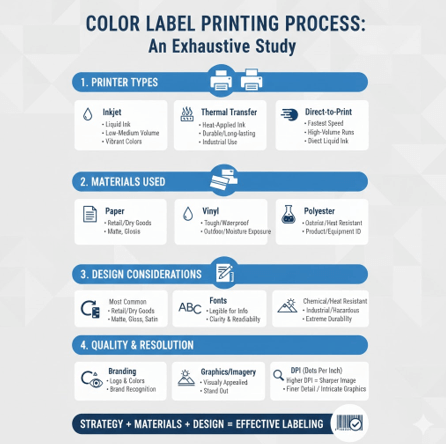
1. Different Kinds of Printers for Colored Label Printing
Different categories of printers are available for color label printing depending on the requirement of a business.
Inkjet color label printers are in great demand since they are reasonably priced and user-friendly. Liquid ink is sprayed onto paper/label stock to create images or text with Inkjet printers. These printers are perfect for low to medium print volume and produce high quality images with vibrant colours.
Thermal transfer printers create durable and longer-lasting labels. Basically, a thermal transfer printer uses heat to transfer ink onto the label material. These printers are most commonly used for industrial applications allowing the user to get high haven’t prints on synthetic stocks and paper stocks.
Direct-to-print printers are faster than other printer types and they apply liquid ink directly onto the label. Label printers can be a convenient and smart choice for your high-volume production runs.
2. Materials used for color labels
The label material is essential so that the print quality of the label is maintained over time. Label materials that are commonly used include
Paper labels are the most commonly used labels. They are best suited for the product that does not require extreme durability. Paper labels make for good retail labels, available in a wide range of finishes, including matte, gloss, and satin.
Vinyl Labels are tough and waterproof; they can be used outdoors or on products that are exposed to moisture. Labeling and Identification of Products, Equipment, and Packages Is Commonly Used.
Polyester Labels: Because they are more durable and are therefore used in industries that require chemical, abrasion, and heat-resistance. These labels are suitable for industrial or hazardous materials.
3. Things to Think about When Designing Labels
Color label printing requires a lot of attention for designing an effective and eye-catching label. Labels must be visually attractive and efficient at helping customers and business. Key features include design
The logo and colors of your brand can be used on wine labels to enhance brand recognition.
Using legible fonts for important information is ideal.
Another way to make your label appealing can be through graphics and imagery. They can make everything stand out and look great.
4. Quality and Resolution of Print
A printer’s resolution is the ratio of the highest level of detail labelled and printed. Printers with higher resolutions enhance the sharpness of images. For those types of prints requiring finer detail or more intricate graphics, a higher DPI (dots per inch) printer is best.
Comparing color label printing solutions: which is right for you?
When deciding on a color label printing solution, businesses should take into account the volume, size, material, and quality of the print. Let’s check the most common printing methods based on some key criteria.
1. Amount of Printing
Printer which prints in low to medium volume, Inkjet printer is suitable for business having less printing requirement. They are economical and can create high-quality prints for smaller quantities.
High Output: A Thermal Transfer or Direct-To-Print Printer is better suited for high volume which needs labels to be made quickly. High-volume printers deliver faster and more efficient printing processes.
2. Labels That Last
Paper labels work well for products with a short shelf life or products that are used in indoor controlled environments.
Very useful for outdoor as per durable nature. Vinyl and polyester labels are better for items that are exposed to the weather or chemicals.
3. Personalization of Labels
Standard Labels: Inkjet and a thermal transfer printers can be made to order for quick and easy custom prints. Inkjet printers print fine images and have a lot of good colors.
There are specialized labels that play a vital role in marketing unique products which are more high-end or luxury products. These include direct-to-print printers setup where one can get higher customization and a quicker turnaround time for a small and medium production run.
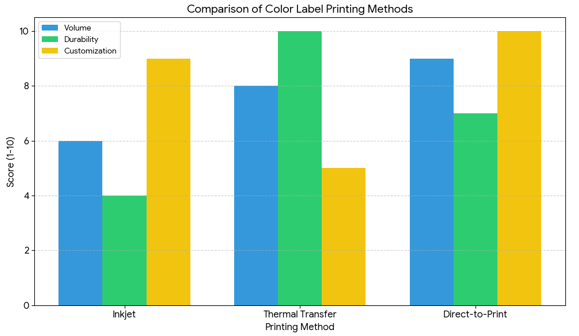
- Durability Leader: Thermal Transfer received much higher durability score than all other methods making it the durability leader. This has become a standard for industrial labels which requires resistance to moisture, chemicals or friction.
- Design Flexibility: Inkjet technology provides maximum flexibility which makes it a suitable option for small businesses that need colorful, high-quality branding and can change its design on a frequent basis.
- High-Volume Efficiency: Direct-to-Print systems are unmatched in the volume they can handle and are custom-built for high-capacity production lines where output and speed are the number one consideration.
- Customization Powerhouse: Inkjet and Direct-to-Print both allow variable data printing fully in color (like serial numbers, QR codes, etc.) to a large extent, which standard Thermal Transfer cannot achieve.
Tips for Successful Printing with Color Labels
To ensure that your colour label printing is working effectively to suit your business needs, here are some tips to guide you.
Select the Appropriate Printer
Choose a printer that suits your volume and quality needs. If you want high-quality prints with finer details, you will invest in a high-definition inkjet or a direct-to-print printer.
Use sturdy materials
Choose the proper label material depending on the product. Choose vinyl or polyester for items that require weather-proofing or exposure to chemicals.
Use Branding in your Design
The design of your label should indicate your brand. Make use of logos, hues, and typefaces that complement your brand strategy for unified looks across various products.
Print Tests
Test prints can prove useful to check how colors, resolutions, some elements of design look on large printing run before committing to them. It will help you to avoid expensive mistakes and keeps you quality controlled.
Get the Most Out of Color Label Printing
Through color label printing businesses can enjoy a plethora of advantages ranging from brand identity and compliance to cost-effectiveness. hkkayu selecting suitable printing solution and materials, businesses can create labels that are vibrant, durable, and functional to make their products stand out on the space. There are many color label printing methods that can help you make the right choice to suit your needs whether you’re in the market for something affordable and low-volume or high-quality and mass-produced.
Custom labels which are printed with all types of colors and required message make a huge difference to a product. Using the tips and considerations detailed above, you can ensure your labels are appealing and functional while being in line with your marketing goals.